Building 1000-year walls, biking in snow, and meeting a cowboy
In mid-February, between snowstorms, I took the train down to Pennsylvania to learn how to stone wall.
I was interested in dry stone walling because it seemed to be the most natural foundation for buildings. No cement, no mortar, just carefully placed rocks. You could even collect the stones by hand, although these days, they’re more often trucked in from quarries. Power tools are also optional, and hardly a hammer is needed, at the essence of it.
And it works! A well-built dry stone wall is known to outlast a mortared one. This might seem counterintuitive, but it’s yet another example of the common wisdom: better to bend than to break. The stones are tightly held together by friction and gravity (strong forces, in walls that are over a thousand pounds per linear foot). Critically, they’re not “glued” together with mortar. In a “all glued together” wall, just one crack that forms from ground movement threatens to propagate through the whole wall. In a dry laid stone wall, stresses naturally generate the smallest, localized shift that will resolve them.

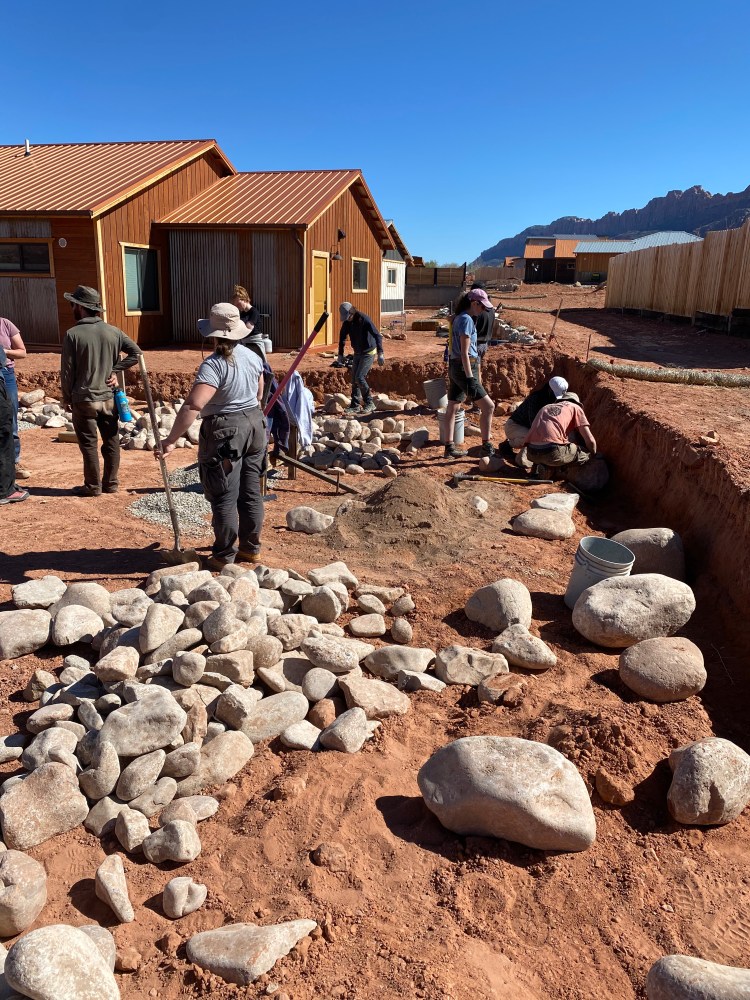
I had gotten a taste of dry stone walling in Utah, where I had spent a day working on a retaining wall before I was sent back to string lining.
Now, with ideas of future buildings built on stone foundations, I was keen to spend a week diving deeper, and take home a shiny certification—not a common thing in natural building.
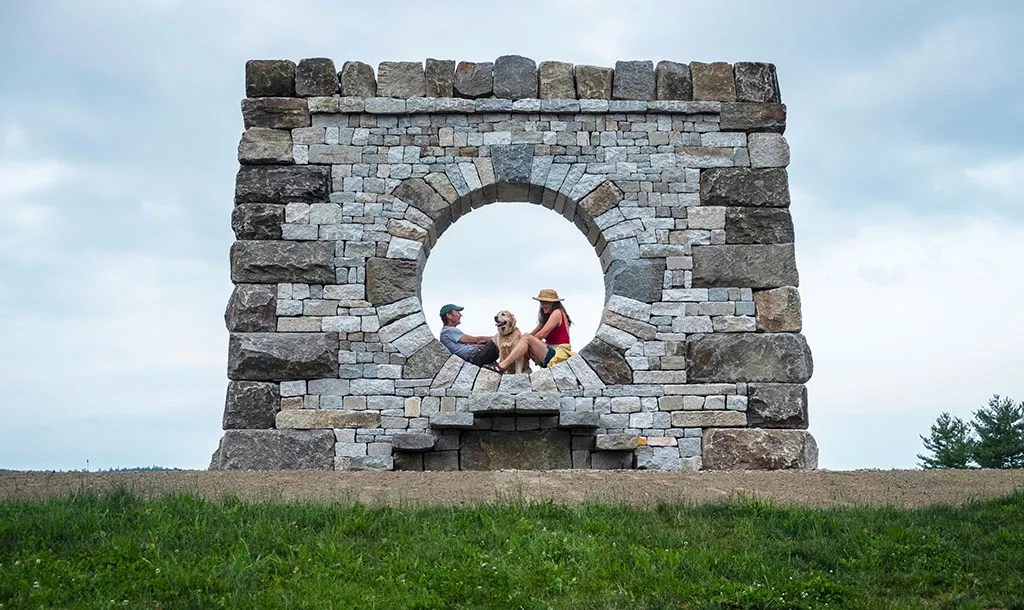
As with much traditional trades activity in the Western world, I had a British organization to thank for this opportunity. The Dry Stone Walling Association of Great Britain (DSWA) was formed in the 70s to revitalize the rapidly dying craft. Since then, it has developed a rigorous system of certification. The highest level takes years, if not decades to reach: one must demonstrate building not only straight walls but ends, corners, stairs, retaining walls, curves, and up slopes, all with exacting perfection and incredible speed.
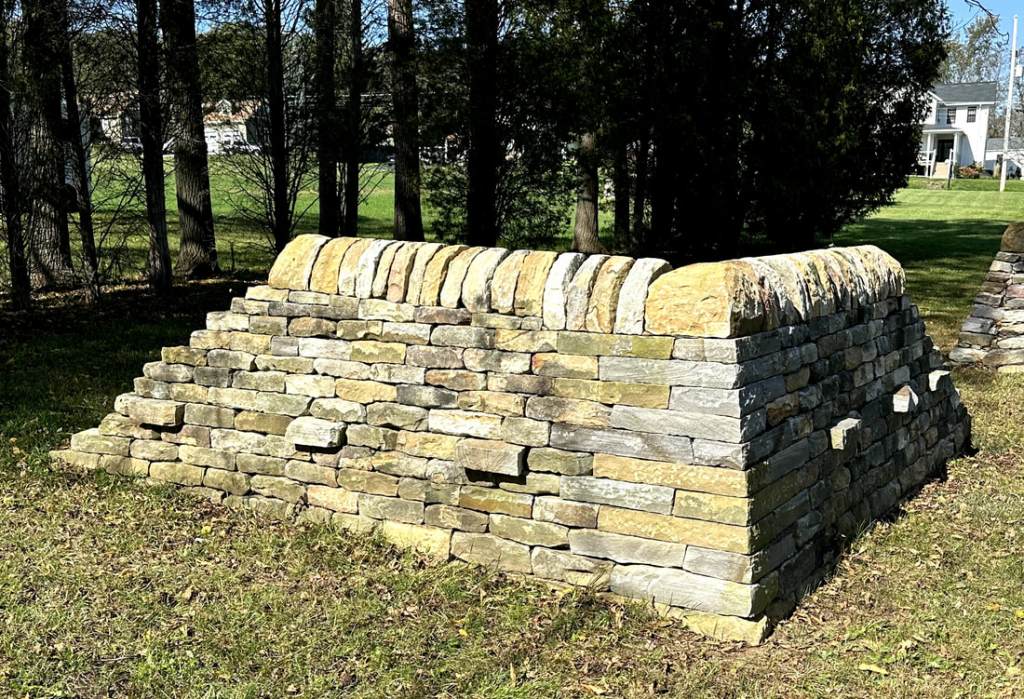
We were just here for our Level I certifications though, which tests the basic ability to built a no-frills, utilitarian wall at professional speed. At the end of this workshop, we’d take the 7.5-hour exam for Level I, overseen by an examiner brought in all the way from Ontario.
I knew before I arrived that I’d be the only woman in the class, not counting one of the two instructors, who happens to be the only Master Craftsman certified woman in the country. Kim and Jerry Coggin are accomplished wallers that own Laurel Stoneworks, where we’d be training all week.
I’d reached out to Kim earlier about whether there were any other attendees, preferably women, who I could ask about sharing accommodations with. She’d told me there were none, which wasn’t surprising.
At 9:06 on Monday morning, I hurried into class, wiping the fog from my glasses. I’d left Johnstown at 7:30 that morning to bike to South Fork, but that hadn’t been enough time to climb the big hill between my AirBnB and Laurel Stoneworks.
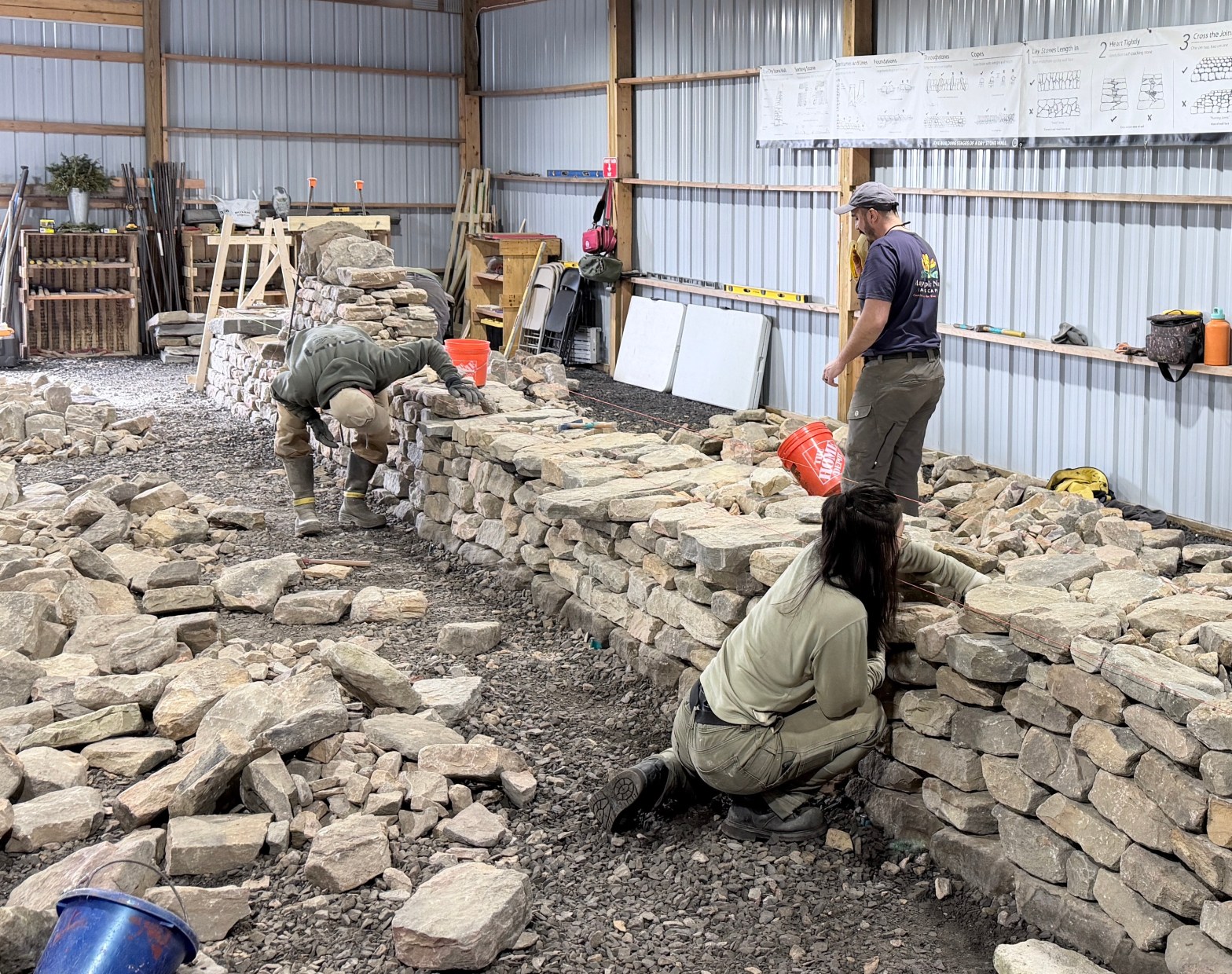
Despite my fumbled entrance, the class went great. Everyone was nice and down-to-earth. On the first two days, we practiced taking down and rebuilding a wall together to learn the basic rules of walling.
- No running joints: one over two, two over one
- Keep the face of the wall against the string line for an even and correctly tapered wall
- Each stone must be touching its neighbors and not wobbling
- Hearting (smaller stones) must be inserted tightly, not just tossed into the voids.
- Stones should lay as flat as possible
- Etc.
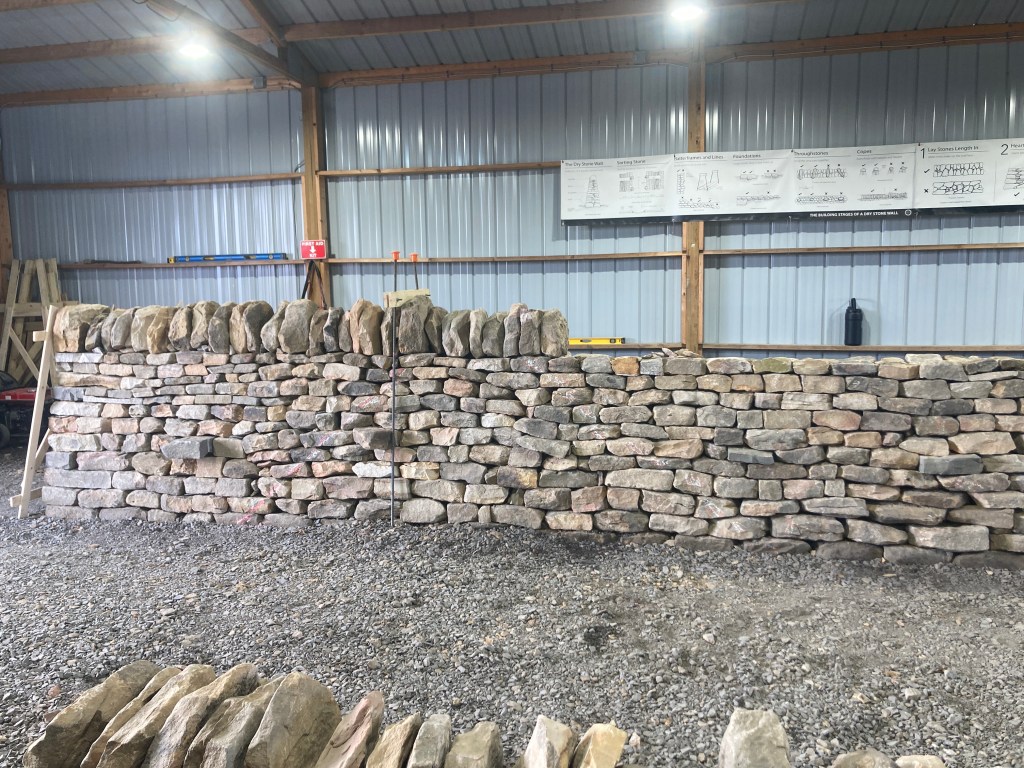
On the third day, we did a practice test, where everyone took down and rebuilt their own section of wall. It was intense—the seven-and-a-half hour time limit looming over us. As the day passed, the faster students outpaced me, first by one course, then two and three. I worked intensely, barely affording the time for a bathroom break. The string line kept moving up. I finished just about dead last, and barely within the time limit.
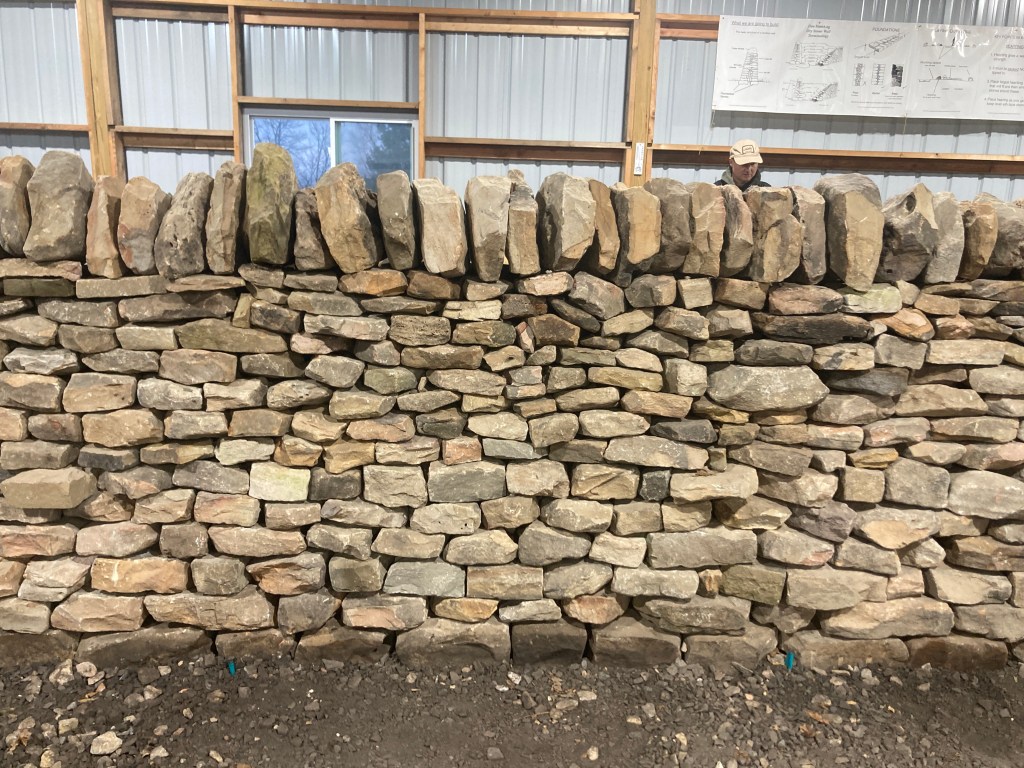
I wasn’t exactly thrilled with my result, but despite this, the instructors seemed perfectly happy with us. I consoled myself as such: 1) There were no points awarded on the test for finishing early 2) The instructors said I’d be fine 3) I was probably the least experienced and smallest student in the class. 4) I could do better on Friday.
The next morning, I got out of bed to some great news. After slinging some 14,000 pounds of stone yesterday, I only had a faint touch of lower back soreness. It was a very lucky coincidence, I thought, that I’d started deadlifting and rock climbing just a few months ago. It would have been awful to be in shambles and then have to do it all over again in two days, right at the peak of DOMS.
On Friday morning, I caught an early morning ride from another student to save some sleep (and energy) before the big test. In just a few minutes, we were up the hill and into the driveway. People had been offering me rides all week, especially the landscaper with a Persian name that everybody was struggling to say. He was driving two hours each way every day, and couldn’t seem to understand why I’d want to bike up a big hill every morning if I didn’t have to.
Though I felt like the oddball of the group, I didn’t feel excluded. Everyone was chill and down-to-business. Maybe it was chattier out by the trucks at lunch, cigarettes smoke curling into the air, but in the barn where I ate lunch, few words were spoken. I didn’t mind the quiet. Maybe people were a little quicker to try helping me with heavy stones once in a while, but nothing offensive.
Test day. When we were loosed upon our wall stints on Friday morning, I jumped into stone-slinging as if I didn’t have a second to lose. The disassembly was the part where physical strength played the biggest role. No thoughts, just rocks, for about 45 minutes.
Once I was back down to bare dirt, I started walling. I tried to prioritize the point-earning, structural essentials of walling, opting for speed over some (supposedly, not point-earning, for this test) aesthetic qualities. As our instructors had told us repeatedly: “It’s not your best work: It’s the work you can do in seven and a half hours. The only way you’re going to fail is if you don’t finish the test.”
A mere 5 or so hours in, our star wallers were putting the final touches on their wall. At around six hours, I was done, and not DFL either!
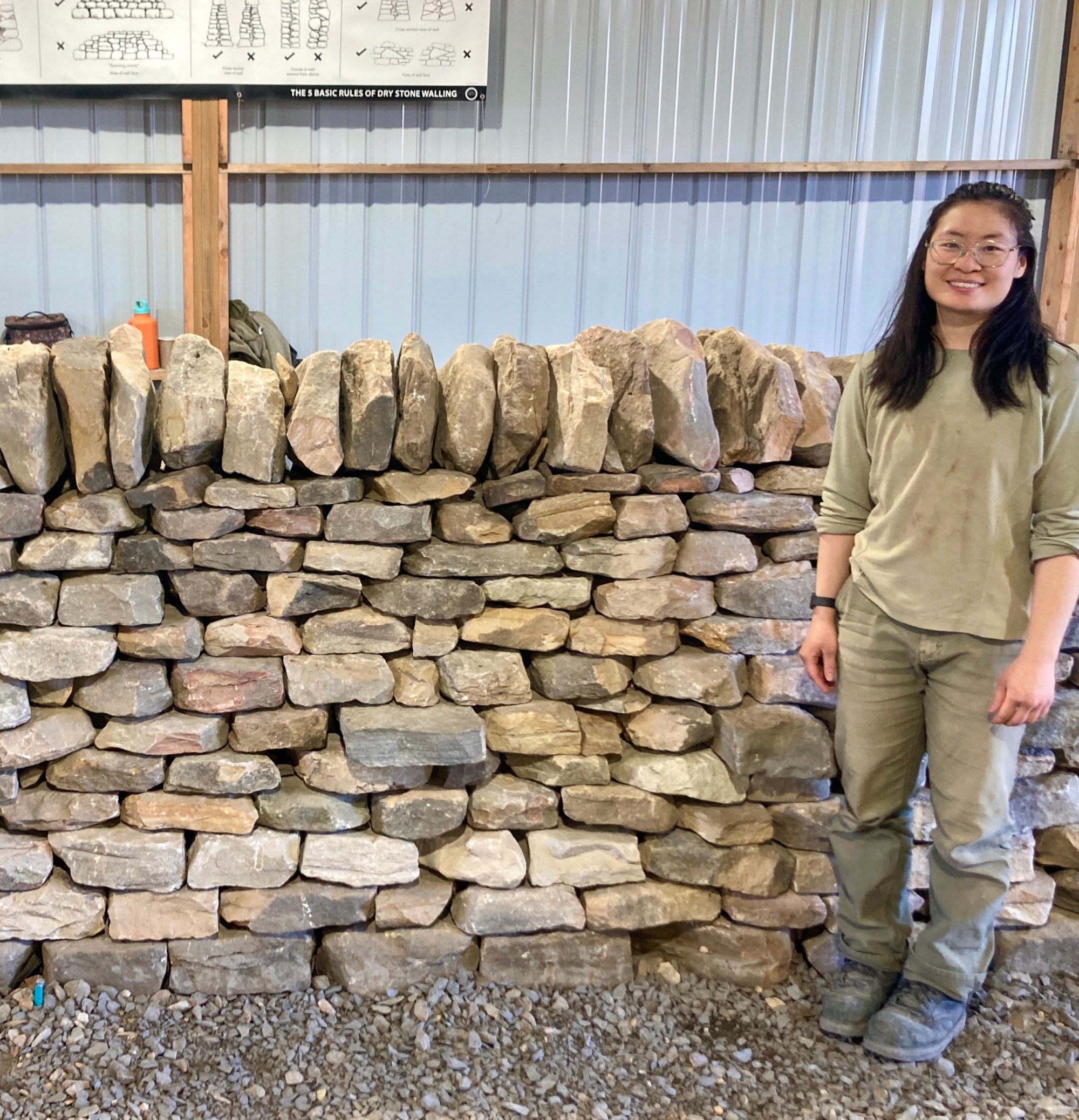
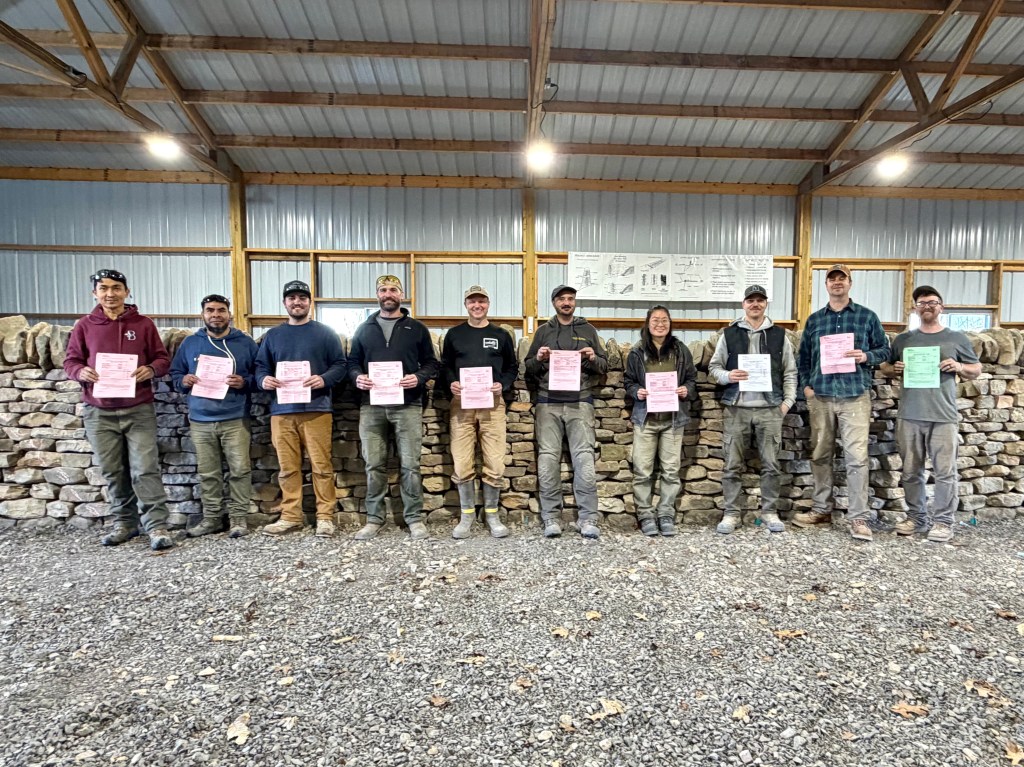
It was a beautiful day: sunny, with temperatures kissing the 50s. Our jolly Canadian examiner loped around, going over score sheets with each student. Everyone had passed, though not all were over-the-moon about their scores. I was perfectly happy with my middling grade. Passing was passing, and a higher score wouldn’t have won me anything different.
My bike and I caught a ride with an attendee headed the same direction to my hosts for the night. As the truck eased up the massive incline that climbed out of the giant geological bowl that housed downtown Johnstown, into the tony suburbs, I felt both guilt and relief that I hadn’t elected to bike.
Hopping out of the truck, I bid my fellow Level I Waller goodbye (“See ya never!”). I sheepishly walked my bike down the pristine, quiet cul-de-sac, and rang the doorbell. Not much of a bike tourist’s arrival.
My Warmshowers hosts would be the last to hold it against me though. They were a super kind couple who worked in medicine, and their bike tourist son had listed them on Warmshowers. I was welcomed into the lap of luxury: a cushy basement bedroom with its own full bathroom. They even invited me out to their routine Friday night dinner.
Snarfing a sandwich in the bar/restaurant, I was in great spirits. My hosts were so fun and easy to talk to, and it was great to eat something other than the microwave-cooked noodle-lentil-cabbage stew I’d been eating all week. I was so glad that I hadn’t stayed another night in the AirBnB. I was getting treated like a king here, and for free? Sometimes, I can barely believe how good I have it.
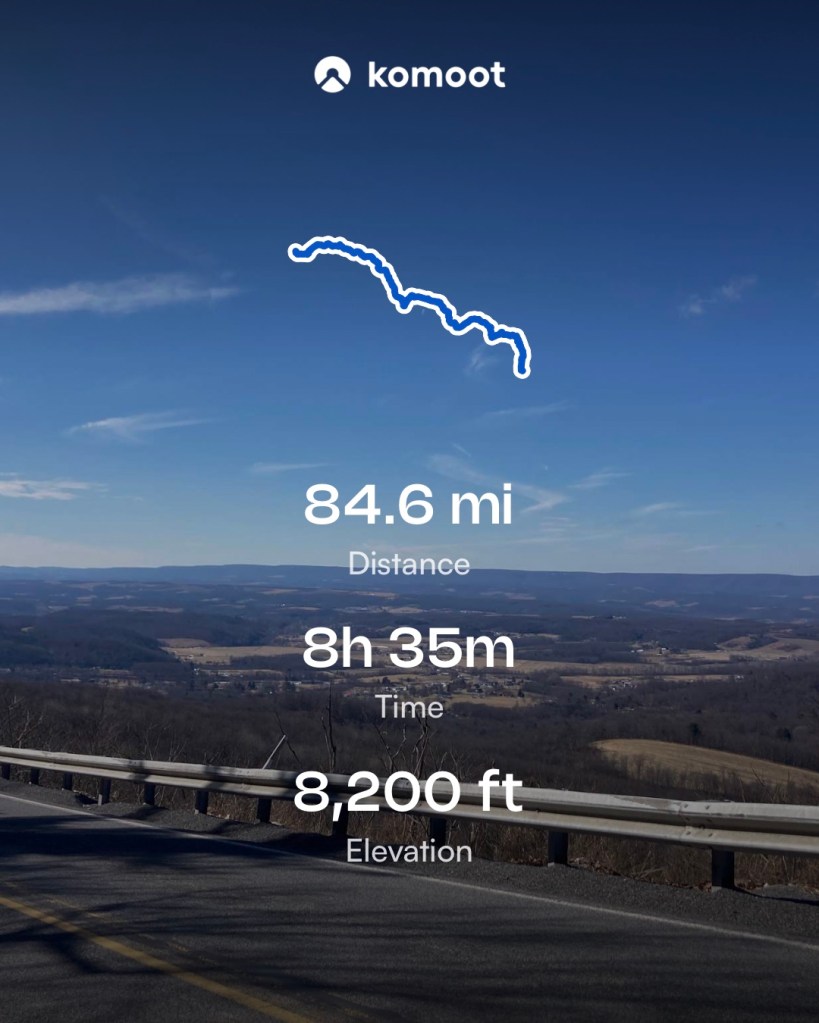
The next morning was foggy, cool, but not freezing. I rolled out not long after sunrise, hoping to make the most of daylight hours. I felt good: I’d fixed my fender rub, pumped my tires, greased the chain, and packed snacks. A snowstorm was forecasted for tomorrow, so I wanted to pack in as many miles as I could today. I’d ambitiously plotted a route to Mercersburg, PA, about 95 miles and 8,000 feet. It would be my hardest ride yet… whether I finished it or not.
Soon, I was sweating and unzipping layers as I pedaled up and down hills. The fog was thick, and any sweat I worked up going up the hills would immediately chill me as cold air rushed through my clothes on the descent. As I wound through quiet neighborhoods, I scanned the horizon for higher treetops. Sometimes it would seem as if I was surely at the top, nothing but white fog on the horizon. Then I’d turn a corner and spot treetops poking out higher in the distance. Goddamn.
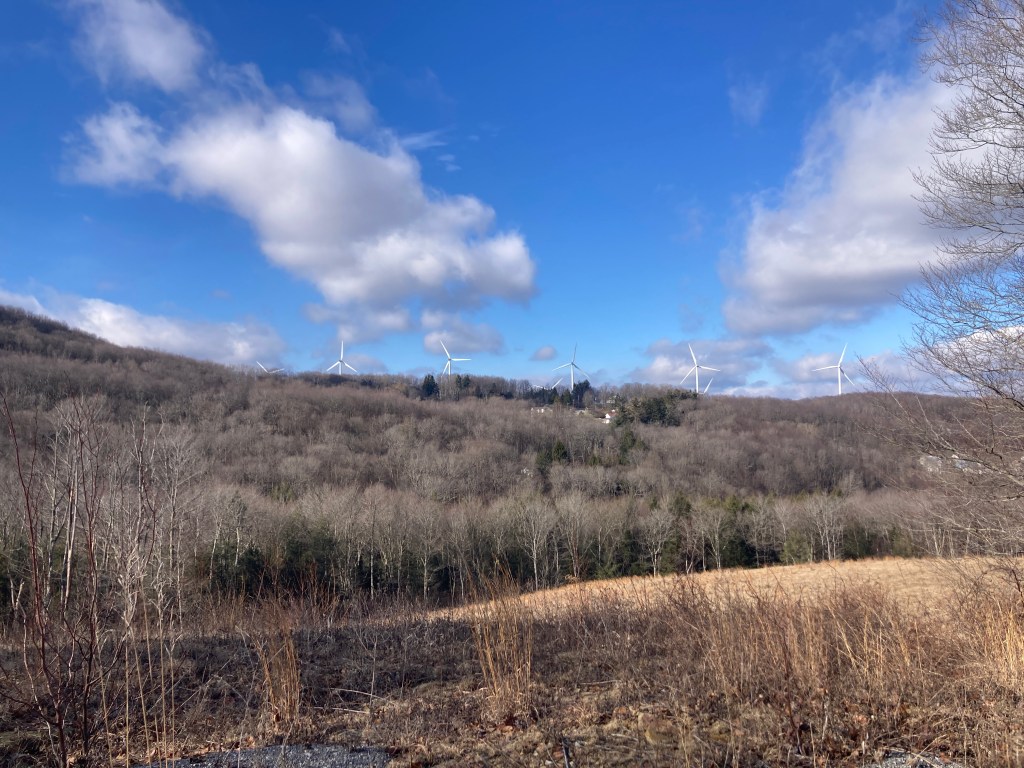
Ironically, I passed by Laurel Stoneworks some 45 minutes in. If I had stayed another night at the AirBnb, I would have been 45 minutes ahead today, but my night of luxury perched above the bowl had been worth it.
The route was mostly quiet roads and scraggly woods with rivers running with snow melt from the warm week. The sun came out and the hills just kept coming. Several were so steep and long that I had to get off and push my bike, which always aggravates my knees. I had hoped to feel a bit stronger from my winter indoor training, but going up a 14% incline with a heavy-ass touring rig is probably always going to feel like a struggle.
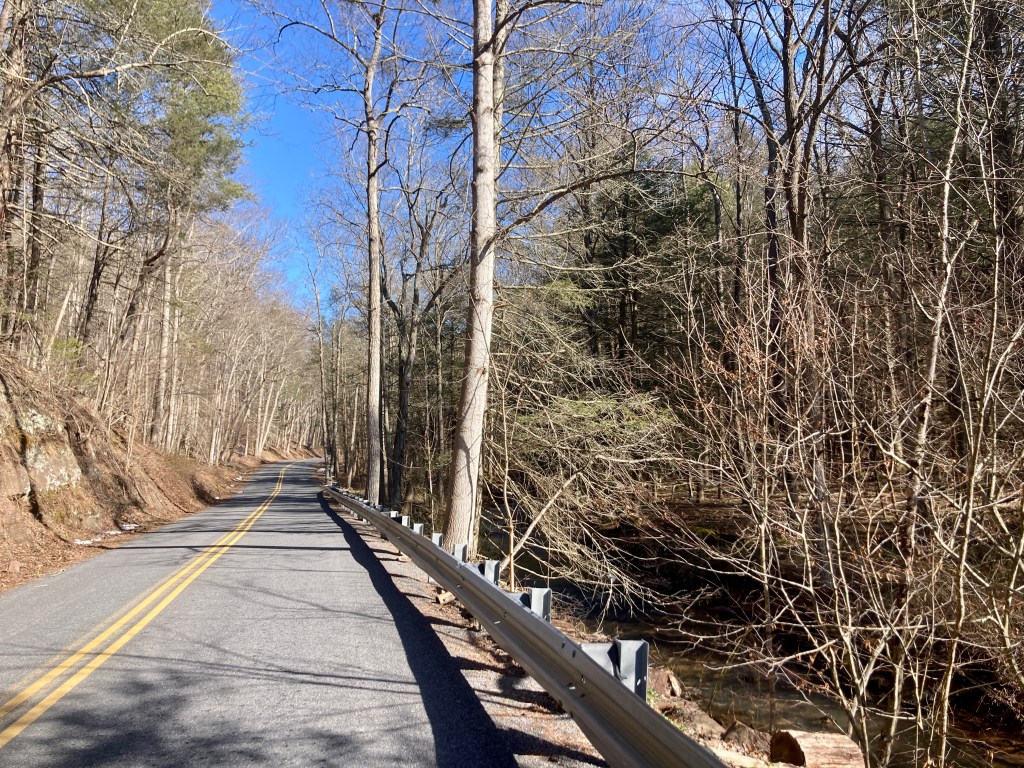
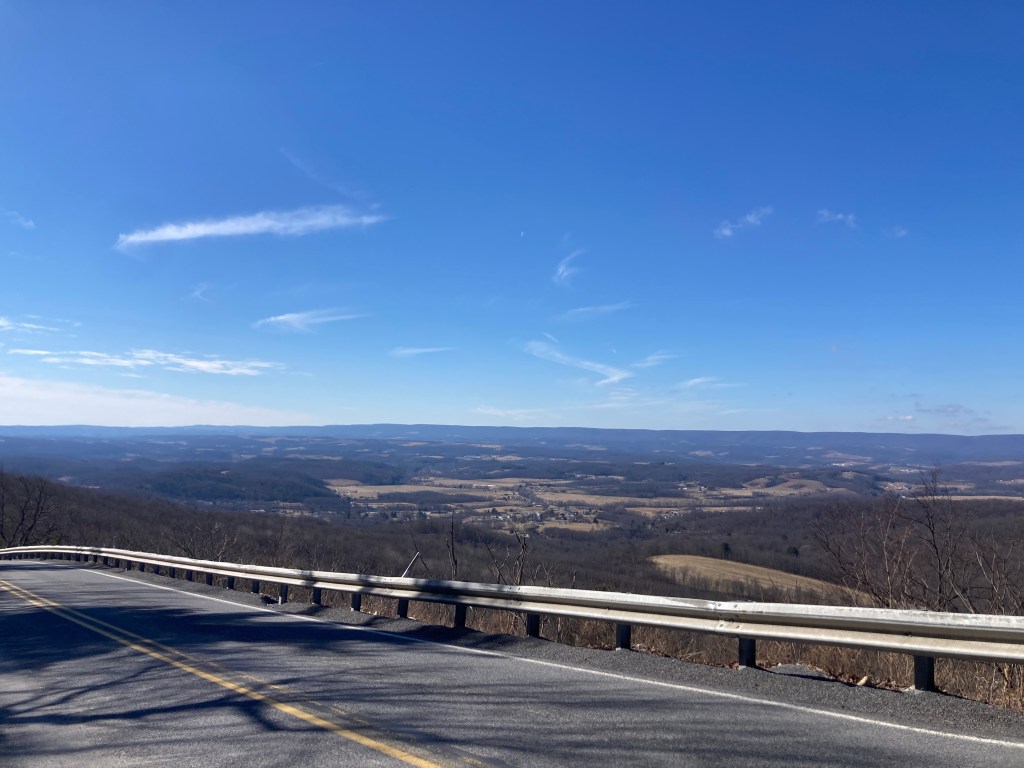
Unfortunately, by the time the sun was setting, I was still about 15 miles out and running out of strength. Each hill was taking more out of me, and I still had one very long hill to climb up into Mercersburg. Why do we have to build on top of hills, I complained to myself.
It didn’t help that I was in a part of rural PA that put me a bit on edge as the sun set. There was a ramshackle house with a lawn full of beat-up cars that a car ahead of me slowly turned off into. A gunshot sounded in the distance. That primal fear of being alone on the road in an unfamiliar place after dark crept out. I gulped some carbs and repeated my mantra of the day: “I don’t give a fuck.”
After dark, I still hadn’t reached the big hill. I thought about it. With legs this tired, just a bit too much steepness would force me to dismount and push my bike, which would sad, slow, and bad for my knees. It was looking like a miserable, scary 1-2 hours. I didn’t want to do it.
I messaged my Warmshowers host and asked if she happened to be able and willing to pick me up from 8 miles away. This was the second time I’d called for a ride mid-bike, the first time being in a heatwave in Michigan. I stopped in the next town and made a quick Dollar General stop while I waited.
Soon, we were speeding up the dark roads to Mercersburg. Sheepishly sat in her truck, I was glad when I saw that last hill. Even at driving speed, it felt like it went on for ages. It was dark, steep, and busy.
I hadn’t achieved the ride I’d set out to do, but I’d still set a personal record for elevation in one day. With touring gear.
It was too late to check out the dining hall at the boarding school where my host worked, which was heartbreaking because an unlimited buffet of food sounded heavenly at the moment. I boiled my packed dinner of noodles, canned beans, and miscellaneous snacks.
The next morning, I woke up to snow. It was coming down thick, in big flakes, though none had accumulated yet. I had a breakfast of tea and my leftover dinner, and off I went, the brimmed hood of my rain cape poking out from under my helmet.
It seemed that I had crossed a line on the drive into Mercersburg the night before. The affluence surrounding me had increased by several notches. The houses were nicer, the lawns more manicured. In between towns was tidy farmland, peppered with the green specks of cover crops and desiccated corn cobs.
I was in good spirits. The hard part was over now, and I only had some 100 miles and 3,000 feet left to cover in two days. Despite the rain and snow, I was much more dry and comfortable, since I wasn’t getting sweaty on hill climbs, and my rain gear worked great.
After a few dozen miles, the snow turned to light rain. No problem. I cruised through small towns, striking an funny figure in my furiously flapping red rain cape. Sure, my “waterproof” boots were finally giving into the unending precipitation, but I was warm enough to ignore the fact that my feet were sloshing in two small swimming pools.
The wealth of historical structures kept me entertained. I was surprised at how often I’d spot a log cabin or some interesting stone work. I even saw a historic lime kiln just off the road, which I wheeled my bike off to go check out.
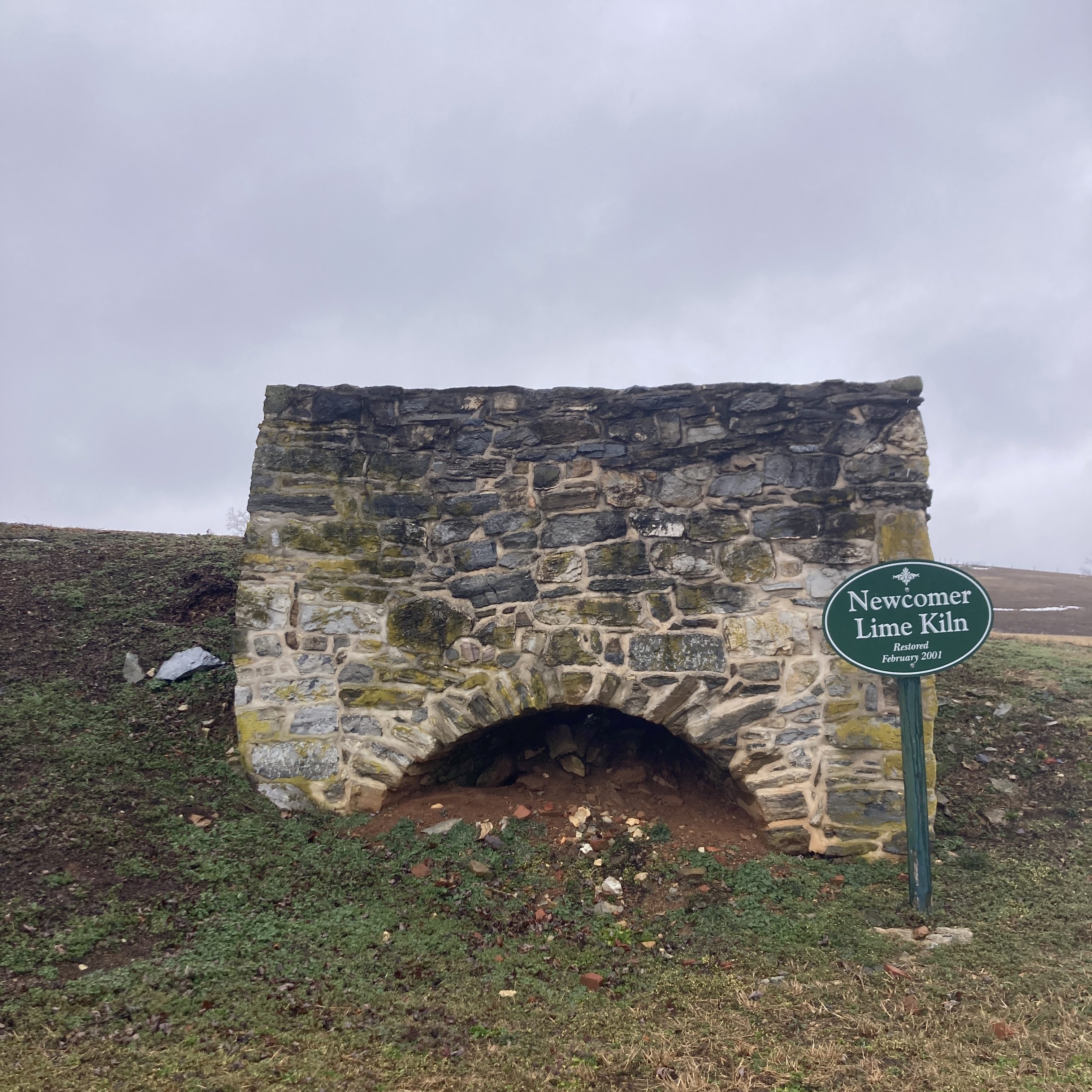
That’s one of the great things about bike touring: it’s so easy to stop and look at things.
Pennsylvania has a lot of old lime kilns. By kilning the abundant resource of limestone, farmers could produce lime, which was used to increase the pH of the acidic soils to make them better for growing. They have long been abandoned for industrial lime kilns, but some have been preserved for our appreciation.
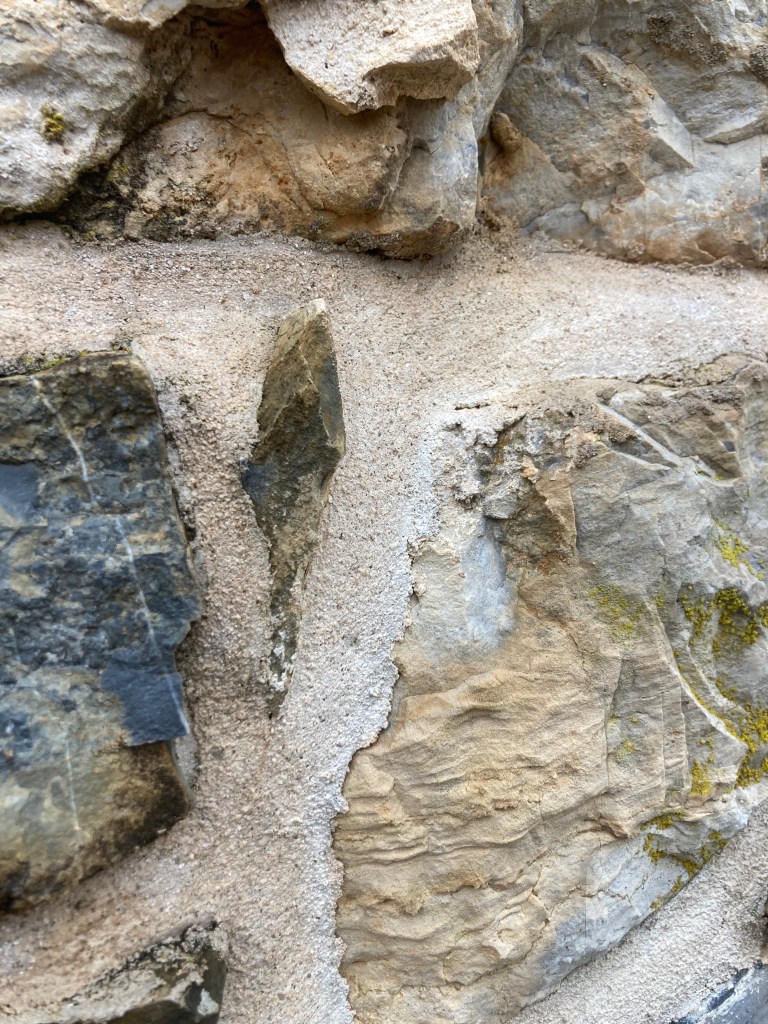
As I biked on, I saw more and more bare rock outcroppings, poking out of fields. I thought about how Pennsylvania gets called “Rocksylvania” by hikers. I had learned this recently from reading North by Scott and Jenny Jurek, a book about Scott Jurek’s 2015 attempt at setting a fastest-known-time on the Appalachian Trail. He didn’t write about those rocks very fondly.
Even with a gratuitous café stop, by merely mid-afternoon, I was rolling down the long, rocky driveway that led to my host’s home. I was staying the night with an interesting semi-retired man. Among his accolades were former cop, polyglot, anti-“War On Drugs” lobbyist, cross-America bike tour, and cross-America horse tour. He signed messages with his nickname, “Cowboy”.
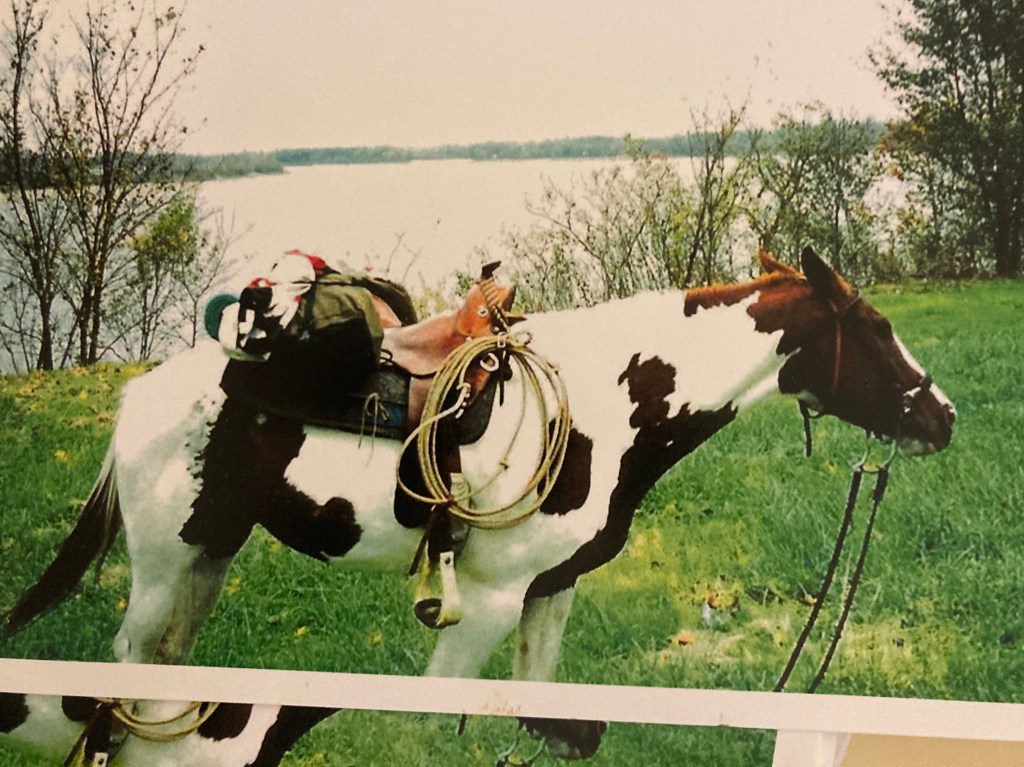
My host was wonderfully gracious, with a touch of old-school chivalry that was grandfatherly rather than creepy. He shared many fun stories about his adventures, and told me a thing or two about horses. I, meanwhile, impressed him by eating like one (if a horse could eat spaghetti.)
It continued to snow overnight. The next morning, with the threat of hidden black ice or potholes, my host talked me into getting a ride to the nearby commuter rail stop and taking it the rest of the way into D.C. “Not today,” [to Death] I thought to myself, which is what I say when I decide to bow out of a bike ride due to some such circumstance.
“You’re not doing it EFI?” he had asked last night, when I was explaining my journey so far. “EFI” turned out to stand for “Every Fuckin’ Inch.” No cars or trains, and if you got bailed out one night, you had to get dropped back off at the same point the next day to continue. It’s an approach that’s often taken with long-distance journeys, when people are trying to make a point, like Scott Jurek setting an FKT on the Appalachian Trail.
EFI didn’t really resonate with my utilitarian, environmentally-motivated approach to bike touring. Firstly, it often wastes fuel because you have to go backwards to continue. It also gives you a free pass to take fossil-fueled side trips. Once I met a couple who did a massive Europe/Asia nearly-yearlong tour, but attended a wedding in the U.S. in the middle by flying there and back. I’m not going to say their tour “didn’t count,” because they didn’t do it for me, but it certainly interrupts the magic a little, like the Starbucks cup that made it into a Game of Thrones episode.
On the opposite end, EFI with all rides forbidden feels too extreme for me. It’s nice to have an out if it’s available and I feel like I need it. EFI is most easily achieved when you are able to prioritize it: I had other priorities, like getting to places on schedule, and not suffering too too much. Maybe I’ll plan a tour some day with the time to do it EFI.
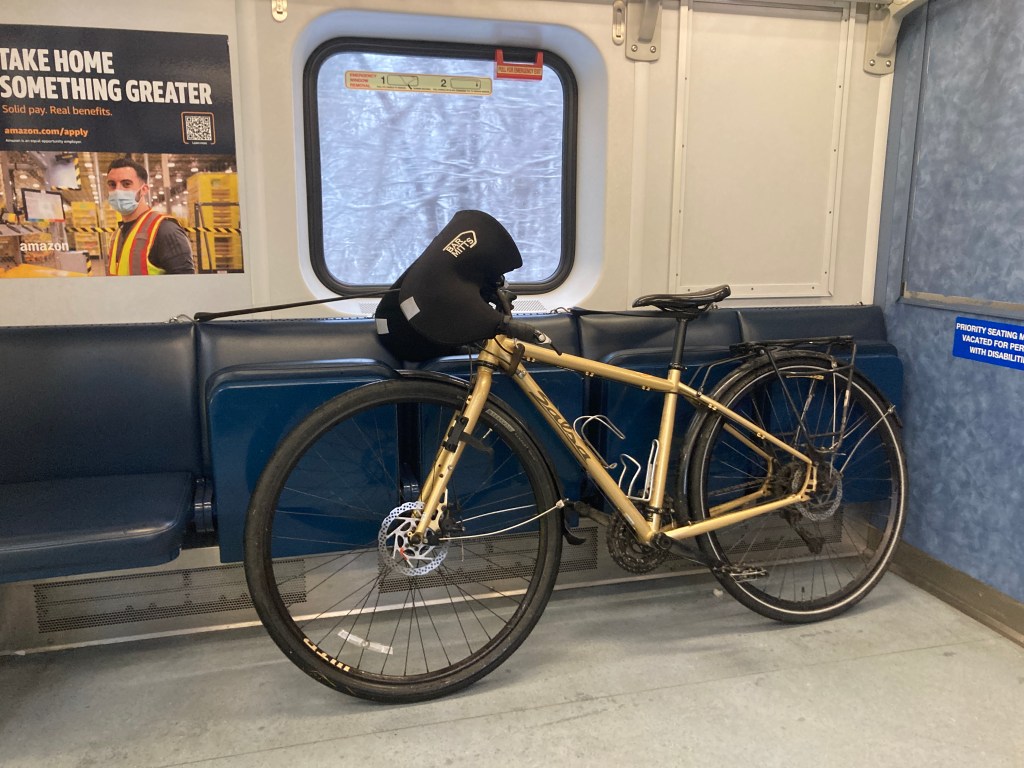
With my unplanned extra time, I had myself a nice little day off in D.C. I made a grocery stop, went to the climbing gym, visited the National Deaf Life Museum, had dinner, and finally arrived at my last Warmshowers host’s place for the evening.
Naturally, she was a delightful human being with lots of cool stories to tell about her Europe-Asia bike tour. Coincidentally, she was also interested in natural building from watching lots of Youtube videos, so it was fun to chat about that, too. Plus, she hooked me on the Moka pot coffee the next morning. I thrifted one right away when I got home that week.
It was a warm and humid morning when I got back to Boston. I don’t think there was some grand takeaway from the trip. I had done what I intended: skill-built, biked, and met some cool people. Maybe I felt a little more myself, after a winter spent mostly in place.
Onto the next.
Thanks for reading, as always. A few other updates:
My natural building workshop schedule for this year is filling up, with more to come. The next one is next weekend in Providence, RI. See my work website for info.
I’m soft-launching a tree walk series at Somerville Tree Club. Build your own hand-drawn field guide to urban trees over a year of guided walks.
I’m also now offering handcrafted clay interior paint services in the Greater Boston area. Paint your walls with minerals, not plastic.
Discover more from evoiding
Subscribe to get the latest posts sent to your email.

